Tuesday, January 24, 2017

Education | Interests | Community Involvement – Wrapping up your resume on a strong note


          Hope you are doing well! Over the last few weeks, we covered the essentials of resume building using the now-famous S.T.A.R. approach and laid out techniques to build a stellar header, profile summary and work experience section covering about 60% of a 1 pager resume. In this blog, we will discuss the final sections of the resume to complete its framework, keeping them minimal to ensure maximum impact!

The Education Section

Given the nature of this piece, if you have all the information for this segment at hand, it will take no more than 10 minutes to complete this section! All you need are the main facts about your degrees/diplomas and to list them in the order of their importance and you’re done.

If you hold any additional professional certifications such as a C.A or C.F.A, create a separate line for them. Remember, as with everything on here - keep the certifications relevant to the job you are applying to!

High School Details: If you are a fresh grad with minimal work experience (or) have been specifically requested by the company to share these details, include your High School details in this section, in the same format as your Work Experience Section.

To include:
Degree Name
Institution Name
Year of Completion
Your score/GPA or rank, if above average, to add perspective
Awards or accomplishments if any

To avoid:
Detailed descriptions of the degree
Lengthy descriptions of your achievement, project details
Listing all courses completed, credit breakdown

Dropped out/did not complete your degree? Many a times, for whatever reason, students do not complete the requirements to graduate. This can be a scary thing to include, but incomplete education is not the end of the world, especially if you did so to follow your passion. If you did start out on a course, follow the 'Things to include' format but instead of writing the Year of Completion, you can say: Completed 2 years of a 3-year B.A. program 20XX-20YY (and even include a reason if you think it reflects positively/explains the change in plan).

Visually, the Education Section looks like this:

P.S. For those who are recently out of college, don't fall for the temptation of making this your resume’s focus! You can still include and elaborate on any work experience before education. Refer to our previous blog to see how you can either:
Include your internship/volunteer experience prior to this section or,
Grab an internship if possible, if you are in want for some work experience

The Interests and Community Involvement Section

This is the last and final section of your resume, as listed by priority. In this section, you get the chance to:
- Show your personality, interests, and passion beyond work and education
- Display your care for the community

Each interest in this section is best kept to a line. To ensure you convey it’s worth in the limited space, carefully craft your content to highlight what’s important. If not, the contents here could work against you.

1.Interests: When we say interests, I urge you to write something that reflects your softer traits in a positive manner. Premier companies pay close attention to these traits as they showcase your true interests and personality, a desirable aspect.

Example:
  • Including the activity with its cause: 'Avid cyclist for ride to conquer cancer' showcases your care for the society
  • Allying out how serious you are: 'Enthusiastic singer training with the legendary Usha Uthup' highlights your creative side
  • Displaying your personal goals: 'Passionate runner training to beat my personal half marathon record' displays your forward thinking mentality
  • 2-time Winning captain of the school football team' focuses on your leadership skills.
 2.Community Involvement: Apart from the above interests, if you have volunteering experience, make sure you include that too! It reflects well on companies if their employees care for the society and it’s a definite asset to your resume. Even if not for the resume, I urge every one of you to go out there and contribute socially in some way. It’s always a win-win-win activity.

Now to structure the above in 1 line, use the following format. Feel free to mix and match based on what you feel is most representative of you.

  • (Use this when you have NO volunteer experience) Half a sentence representing interest 1 | Half a sentence representing interest 2
  • (Use this when you have one interest (or) volunteer work that is very substantial) Full line covering the interest or volunteer work with impact
  • (Use this if you have volunteer experience) Half a sentence representing interest | Half a sentence representing your volunteer work

Pro Tip: Avoid generic interests such as watching TV, reading, playing video games, exercising or vlogging. I’d rather you have more depth in a few interests than breadth. Make your talents or passions interesting with the right amount of detail :) For example: 'Avid reader of autobiographies on a 2 books a month spree’ or 'Entertainment vlogger with 300+ YT subscribers'

P.S. For those who are just out of college and no work experience to your name, except for volunteering activities, skip the volunteering section here and refer to our previous blog to help you call out the volunteering as the focus of your resume.

Aaand.. stick a fork in it, because you are done! With this, you have completed all the sections required for a 1-page resume.

Below are the blogs you can look forward to, to wrap the Resume series before we move to the next section!
  • Visual & formatting best practices to elegantly package your resume, tie a bow on it :)
  • Have a conversation about references and where they can be included
  • Cover letters to maximize your job pursuit
  • Finally, I’d like to share a few important online tools that will come in handy. Thank me later ;)

In the meanwhile, it's time for a quick EXERCISE!

Now that you have your title, summary, and most importantly - your work experience section in place, you are nearly done. Scan your existing resume for any remaining content and organize them into:
  • Education & Professional Development
  • Interests & Community Involvement

If there’s anything that does not fit into the last two categories, it may be time to critically review these items and remove or categorize as necessary. Refer to the blog to keep these sections simple yet effective! Share the completed resume with team@corpversity.xyz to get it evaluated with additional suggestions. You’ll be well on your way to having an impactful resume! For further services, please visit www.corporatereadytest.com/resume and get your complete resume scanned, all for a nominal price!

Stay Tuned!

"Never be afraid to fail. Failure is only a stepping stone to improvement. Never be overconfident because that will block your improvement."

Manish N Gaba
(Pic Courtesy – Unsplash)


Corporate Ready Test, Corpversity and its Related Ventures are Copyright © 2016-to date by Career Ready Consultants LLP, All Rights Reserved. 

Sunday, January 15, 2017

Create an unforgettable “Experience” with your resume & make it beyond the recruiter's first nod!


In our last blog, we discussed ways to create a stellar header and a profile section ideally covering the first 20% of your 1 pager resume. In this blog, we progress to the next 40% of your resume and learn how to create an irresistible work experience section.

The key to making an impact with this piece is to go beyond merely listing your past jobs, and structure it so it covers the key areas of context, your contribution, and impact on that job, that the recruiters are looking for. This often covers the job and the and the duties that entailed. Remember, hitting the right keys gets you that much closer to having the recruiter move you up on their YES pile, and even sealing the deal. the more relevant you can make for the recruiter and the interviewers, the better the outcome.

First, the content: Usually, I approach this section using a combination of:
  • Listing my work experience in reverse chronological order (starting with the latest gig first) and
  • Too many to list? Filter in relevant positions to the job you are seeking to stick to the 40% of a 1 pager resume.

For example, if you are applying for a sales job, and have held relevant sales positions in the past, prioritize those in the resume in reverse chronology and de-prioritize jobs you may have had that are irrelevant (e.g. finance or engineering experience in this case).

As with all rules, there are always exceptions to filtering out irrelevant jobs:
  • The job had skills that are transferable, keep it in: For example, if you are applying for a finance job at a bank where your background of data analytics can help, or you were a customer service rep and want to move to a sales job to apply the usefulness of your calling experience, keep it in and highlight the skill that is relevant.
  • If you worked for a very big brand: If it is relevant experience at a big-name company, there is nothing like it. But even if the experience is irrelevant, keep it in to show you know what it’s like to work at a top place, and make sure you have a good story or a reason as to why you are shifting portfolios.
  • If you do not have enough work history in the relevant portfolio: In this case, showcase what you have been up to in other areas, and in addition, ensure you have a good reason for your shifts. Draw some transferable skills from your previous experience regardless of the industry, to make the most of it.

Next, the structure: The Company name, job position/title, projects under them and awards are the basic ingredients of say, a salad. Make this salad tastier (and in my case, edible) by sprinkling it with a special dressing of attributes.

From my sales experience, I’ve learnt that there are 6 main desirable skills or attributes for a sales person in the business. I’d organize everything from resumes to end of quarter evaluations along those skills as all companies look for those very same key attributes in their job portfolio. I highly recommend thoroughly researching the job you are applying for & enrich your resume by inculcating these attributes where it fits best within your experience. They give big hints to your recruiter on your experience's relatability and transferability to the new role you are applying for and ultimately makes it easier for them to connect the dots.

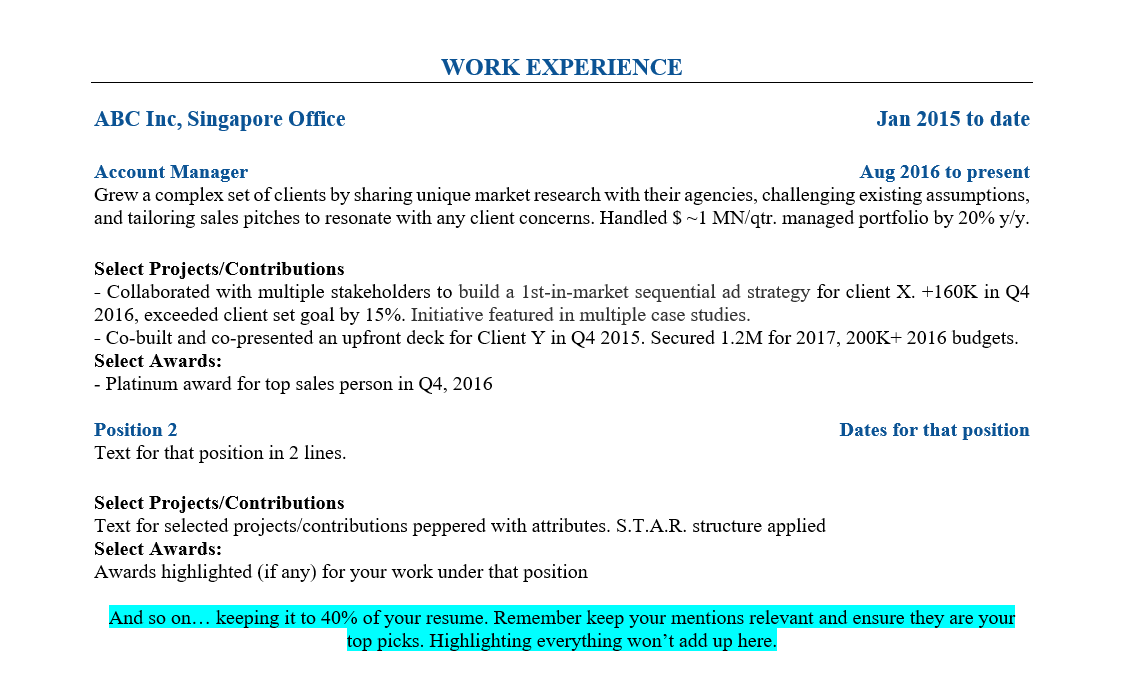
Tossing the above together will give you (in reverse chronological order):

Company                   Dates: When you worked in the company (right hand)
--------------------------------------------------------------------------------------------------
Position 1: 2 lines with numerical impact            Dates: When you worked in the role (right hand)

Select Projects/Contributions
Project 1: 1 to 2 lines with numerical impact using S.T.A.R (with desired attributes weaved into the sentences)
Project 2: 1 to 2 lines with numerical impact using S.T.A.R (with desired attributes weaved into the sentences)

Select Awards
Awards 1
Awards 2

 The above sample illustrates how relevant, structured content can have an impact in this section. 

If you don't have formal work experience: No sweat! There are two scenarios:

1) You do not have formal work experience but have internship and volunteering experience, showcase those experiences in the above structure and create an "Experience Portfolio". Remember, every role counts. 
  • Share the company/organization name
  • Share your title in that organization
  • Share the time you spent in that role (if it’s part-time, mention that and provide a timeline)
  • Share any projects under that title and call out attributes or skills you picked up from the opportunity, that relates to the potential role (think Data analytics, sales, operations, technical, coding etc.), and provide tangible outcomes to the best of your ability.  

2) You have absolutely no work experience: This applies mostly to full-time students. While focusing on your studies and exams is your primary responsibility, companies look for a well-rounded candidate, so some external experience apart from your marks shows your interest & experience in other areas. Get online and look for opportunities that excite you. Believe me - you will not regret it!

(P.S. If you are interested in sales, feel free to apply to our company - Corpversity. We are always on the lookout for passionate sales interns who want to make a mark! Send your resume and why you want to apply- use the tips from our previous blogs for bonus points- to team@corpversity.xyz)

In our next blog, we will cover the final 40% of a resume. In the meanwhile, try out this exercise to be on your way to creating an impactful resume for yourself!

For those of you with work experience: Compare the 'Work Experience' section of your resume with the one displayed on our blog. Note the differences and, as suggested, modify your resume to make the section as relevant as possible. Tailoring your section to remove any unnecessary information, and to cover 40% of your 1 pager resume.

Candidates without work experience: If you have been involved in internships or volunteer work, details of those experiences count towards crafting your experience section. If you do not have any work experience, I’d highly recommend you to go out and try volunteering, interning or even a simple part-time retail job behind a store counter. It’s time to roll up your sleeves while you still have time, as every bit counts towards your resume.

Share your modified resume with team@corpversity.xyz to get it evaluated with additional suggestions. You’ll be well on your way to having an impactful resume! For further services, please visit www.corporatereadytest.com/resume and get your complete resume scanned, all for a nominal price!

Stay tuned for more!

"Everything is perfect and there is always room for improvement - Shunryu Suzuki"

Manish N Gaba
(Pic Courtesy – Unsplash)


Copyright © 2016-to date by Career Ready Consultants LLP, All Rights Reserved. 

Thursday, January 5, 2017

Craft a Stellar Header & Profile Summary for Your Resume


       It’s no secret that first impressions matter. How would you like to impress the recruiter in the crucial first moments by beginning your resume with a dashing Header & Profile Summary? As we touched on in an earlier blog, these sections start off the resume. The recruiter is psychologically pushed to either decide to place your application in the green stack or the red from the very beginning, giving these sections immense weight. For this reason, the contents would do well to demonstrate:

- What your Brand can offer specifically to the company you applied for.
- Your consideration of the recruiter's time: Provide relevant, concise information that makes decision-making simpler for the recruiter.

Many applicants make simple errors and fail to make an impact with these two sections when it can easily be avoided. Adding irrelevant information multiple times in various sections causing redundancy, or elaborating on what they would like to be offered where they are expected to provide information on what they have to offer, are some of the common mistakes I’ve noticed over the years.

Below, I’ve elaborated on the DO's and the DON’T’S for these sections, along with many more. For now, let’s not worry ourselves about the styles, colors, formatting etc. of the resume. We’ll discuss the visual, verbal and formatting best practices in upcoming blogs in due time, once the core components have been mastered. But first, remember to craft these two to cover 20% of the resume page at the most. Being concise is a challenging art that is worth the efforts.

The Header Section
DO's: Make it sharp, professional, space-saving and on-point by including the following pointers and pro-tips:

1. In the front center, start with your name in a strong font style with relevant Post Graduate titles beside your name (if any)
  • Pro Tip: Middle names, with their lengthiness and lack of need, are best left out.
2. Add your main e-mail address (ensure you check this email regularly).
  • Avoid sharing unprofessional email handles such as name+rockstar@ or name+verysweet@ or name+kingoftheworld@ etc. Best not to have your resume touch these IDs with a barge pole ;) If you don't have an email address worth sharing professionally, no sweat- now is your time to create one. I suggest creating one with popular email services such as Gmail or Outlook. This not only helps with the perception on the resume but avoids having your email (with your resume) pushed to a recruiter's spam folder.
  • Pro Tip: If you have an official or student email address, it’s best not to share these as both will expire if you truly intend to move on to a new job.
3. Contact Number: One direct phone number that’s in use, along with the area and country code is good to share (preferably your personal mobile).
  • Pro Tip: Cover your basis by adding a concise and professional voicemail message if possible, for those unavoidable times when you are unable to answer the call.
4. LinkedIn URL: I strongly urge you create a LinkedIn profile if you don’t yet have one.
  • Pro Tip: Use URL shorteners like bitly.com to save space while sharing a valid link to your online profile (You can even customize your short link to a relevant name. I strongly suggest you do this.)
5. Location: You may provide your City of residence.
  • Pro Tip: Share your area code. Many a times, recruitment decisions can be based on the candidate’s place of residence, and recruitment agencies may require Pin/Zip codes in addition to the city (full addresses are usually irrelevant in today’s world).

With this, you have a smart, short and sweet start to the resume. The sample below shows what this would look like: 


DON'Ts: Some Don'ts may have become evident to you from the above paragraph.  They include:

1. Taking a significant chunk of space to write “Resume” or “CV” or “Curriculum Vitae” in flamboyant fonts is unnecessary. In most cases, they should have been given the context either by you or a middle-man that they are reviewing a resume.
2. Irrelevant details: Middle names and family details (such as parent names, occupations, passport numbers, full addresses, photos, multiple contact details, links to your social media profiles such as Facebook, twitter, date of birth, sex, religious beliefs etc.) Just don’t.

The Profile Summary Section
This is a short blurb about yourself that gives the recruiter a hint of what you specialize in/hope to focus on. The requirement for a profile summary has long been a debate and is still under contention to be honest. But given my own experience and research, I’ve decided to include it as a part of the core resume structure as it’s been a lethal elevator pitch for me and can be yours too if done right. In the end, if you don’t feel comfortable or don’t see it fitting well with the rest of your resume/experience/industry, feel free to skip it.

DO's:
1. Keep it concise: A general rule of thumb is to maintain it at 3 lines. A subtle change in font color and spacing can separate this section from the Header.
2. Highlight: Bolden the right content in the sentences for maximum impact. I personally love this, while my better half prefers not to intersperse text with bold font. Feel free to pick what you feel best :)
3. Customize: Show how you and your skills are useful to this specific employer. In the below snapshot, I’ve related my lines to the pre-sales analyst role I’m gunning for. The set of current skills, responsibilities, and expectations listed closely reflects or addresses potential responsibilities required for the role (review the job description closely to gain this information).
4. Focus: Highlight one relevant quality that you possess & engage your reader by elaborating on it. While 3 lines may not seem like a lot, great stories have been written in less.
5. Numbers: Demonstrate your result driven mindset by quantifying any of your skills with a combined, high-level number that denotes an achievement across your experiences or student-life (for instance for teamwork: Was in the 90th percentile or above in all my team assignments). It may not be the most obvious, but dig through and I’m sure you’ll find it. There are few ways to pop-out of the page at a recruiter, this being one of them. See sample #2 below for another example.

#1 Example for candidates with work experience:

#2 Example for student candidates:


DON'Ts:
1. While you are encouraged to mention the industry you are interested in and tie it with your skills. I suggest leaving out inward looking objectives that are narrow in nature as they may not only derail your chances if there’s a mismatch in interests, but they focus more on what you want and not what you can give.
2. Being ambiguous will not make for a good read. List of words and phrases like “hardworking person”, “never say die attitude” etc. do little to move the needle in your favor. Your experience and education will surely bring out your best skills not to worry!
3. Lengthy summaries: They are an oxymoron. Work with the 3-line rule and make it work.
4. Skills: Again, they only act as fillers, consider avoiding them. 

Example Snapshot:


In the upcoming blog, we will tackle the next two sections that follow these in your resume, with the use of the S.T.A.R technique that we reviewed earlier, for an oh-so-big impact!

For this week's exercise: Compare the header & profile summary of your resume with the ones displayed on our blog. Note the differences and, as suggested in the blog, modify your resume to remove any unnecessary content and fill no more than 20% of your resume with the Header & Profile Summary sections.

Share the updated Header & Profile Summary with team@corpversity.xyz to get it evaluated with additional suggestions. You’ll be well on your way to having an impactful resume! For further services, please visit www.corporatereadytest.com/resume and get your complete resume scanned, all for a nominal price!

"There is always space for improvement, no matter how long you've been in your domain"

Manish N Gaba
(Pic Courtesy – Unsplash)


Copyright © 2016-to date by Career Ready Consultants LLP, All Rights Reserved. 

Saturday, December 24, 2016

The S.T.A.R. approach lives up to its name :)


          From my initial days as a fresher in the corporate world, as I started on projects and day to day work, I came to realize that structure is essential. It is something that everyone values as it gives clarity, helps make decisions faster and process information better. As I moved on to my second year in the company, I got an opportunity to try for a competitive sales role (for 3 months) in the same company, in Africa! However, I came to realize that both in terms of my resume and my interviewing skills, I was unprepared to showcase my work. This was not due to a lack of accomplishments or eligibility, but more because I did not have a structure that highlighted my work in the best possible manner. I could convey my past projects and accomplishments, but it was not reflected as efficiently as needed. I realized, that while being vivid and fluid brings vital color to a conversation or a resume, a method to the madness helps put best foot forward, capture all your work and helps others grasp your thoughts upfront.

Making things organized is the key to moving things faster. I was introduced to the S.T.A.R. concept soon after, and I can vouch for the fact that it lived up to its name. It is a method that can be used for any accomplishment or task by divvying it into 4 sequential points that can each be lengthened or shortened as needed. If you are not already familiar with the method, I’ve detailed the components below:

S: Situation - What was the situation/context or the problem statement?
T: Task - What was the key target or goal you were driving towards?
A: (you guessed it!) Action - What did you do to achieve the target?
R: Results - What was the measurable benefit/outcome(s) of the task (numbers are key here)

A good rule of thumb is to always start the statement with a verb (Managed, Revived, Organized etc.). You can follow this for daily communications, projects and reports, end of quarter evaluations and ultimately in building resumes and even in answering in interviews. I now apply the 4-point star literally anywhere I need to present my work!

It is easier to use the S.T.A.R. in projects, reports, and even interviews since there is leeway that allows you to explain a situation, task, action and results in more than just a couple of lines. However, I bet you remember from my previous blog that a resume is best kept short - where you can preferably pack everything in a single page. Here’s how you can summarize your accomplishment while using the STAR method:

There is a saying - If I had time, I would write you a shorter letter. I love that saying. Because time is valuable, and a summarized communication (be it a resume or an email) values and respects the reader’s time. While elaborating on a structured story is a tempting thing to do, shortening a story to a line or two takes time and effort. Nevertheless, it is a challenge can be tackled with practice and skill.

For instance, I recently came across an application for our internship program that had a lengthy accomplishment statement for a substantial achievement (the name and the written content is modified for privacy). Even though it was probably an impressive accomplishment, it was unclear how the intern helped make the situation better as it lacked structure and the important components needed to assess it.

Original Achievement:
“Chief Editor in Department: My department had no magazines launched for many years due to money problems, and we had no sponsors. I became the chief editor of the magazine this year as the HOD saw my potential in my 1st year as a sub-editor. With my team, I helped relaunch the same under a new brand name and design and also got sponsorship to fund the magazine. We launched and circulated this new magazine in our college fest and lots of people bought it.”

Now, let’s implement the STAR approach to the statement in 2 simple steps
  1. Recognize and break it down into its sections:
S is - Department magazine is dysfunctional for 3 years
T is - Reviving the magazine
A is - The chief editor motivated a team of 2 and bagged an external sponsorship of 25K to create the magazine
R is - It circulated a record 1000 copies in their college fest, where that number is a clear achievement point, and shows where the person's efforts ended.
  1. Pull the section together to form a cohesive story:
“Chief Editor, Economics Dept. (2016-17): Revived our department’s magazine, from a 3-year slump, by acquiring an external sponsorship of Rs.25K. Motivated & led a team of 2, creating and circulating a record 1000 copies at our college fest."

While it may take 3 or sometimes more iterations to get your S.T.A.R. story tight and in order initially, once you do get the hang of it, it will be a great asset not just on your resume but anywhere you want to call on your past achievements- big or small- to make an impression!

We will continue to refer the STAR method in our coming blogs, as we break down the components of the resume structure, and layer it with the S.T.A.R. approach, in addition, to create an impact across all of your resume’s core sections. As a bonus, look out for our tips on resume content customization for various applications (based on the skill requirements, role, industry etc.)!

In the meanwhile, now that you know what the STAR approach is and how to use it, we have a simple activity for you on this method! Pick any statement describing your past accomplishments in your resume (or) a question you answered in an interview. Now based on this blog, apply the S.T.A.R. technique and mold your statement (or) answer to include all its elements. Share your updated answers with us at team@corpversity.xyz and you’ll get an evaluation plus additional suggestions from us, to make you resume have the greatest impact! For further resume related services, please visit www.corporatereadytest.com/resume and get your resume scanned thoroughly, all for a nominal price!

"If you are facing the right direction, all you have to do is keep walking"

Manish N Gaba
(Pic Courtesy – Glen Carrie from Unsplash)

Copyright © 2016-to date by Career Ready Consultants LLP, All Rights Reserved. 
Friday, December 16, 2016

Resume building - It's that time of the year!


          As we try and keep ourselves warm and cozy this winter, as promised, I’ll be shifting gears for the next few write-ups, where you’ll see me discuss the nuances of resume building and how you can capture your best work on paper (even if it’s not extensive)!

For all final year students graduating in the coming months: you may be participating in placements soon and these next set of blogs from me are especially for you! For those of you not yet in that stage of your student or professional life (or past that stage), this is still applicable to you. Equip yourself with what you will inevitably need in your career - valuable resume building skills to stay ahead of the game.

Why a resume?
Let’s consider this. A product being sold today still benefits from marketing - be it digital or physical - to introduce its presence, uses and benefits to the market effectively. You can very well treat your resume as the marketing poster that sells you (LinkedIn being the digital equivalent with the same purpose). It is a record of who you are, your accomplishments and what you can contribute by highlighting your key skills and competencies and displaying your interests to a potential “buyer” of your services.

Resume Customization
While preparing for the interview takes significant time and effort, surprisingly, professionals discount the amount of attention required for the other vital aspect of recruiting: building resumes. While they may not seal the deal, their customization has the ability to make or break first impressions, which are not always in person.
  • First Impressions last a lifetime. If you do stumble on making the right first impression with the interviewer, the rest of your recruitment process could become an uphill battle: The time spent by recruiters on each resume is negligible. According to recent research, with the advent of technology, machines scan a resume at an average of about 6 seconds! Within these few moments, you have a fleeting opportunity to make an impression. If your resume, in that time does not cater to what the recruiter is looking for, what could have been the beginning of a great opportunity can quickly turn into a wrong turn where you are out of the race before it starts.

  • Getting an interview with a company is more of a privilege than a right. Get your foot in the door and then proceed to prepare for the interview: Your resume decides your chances of getting an interview. Even if you manage to get through without needing it, your interviewer would have most likely requested for and seen your resume before meeting you in-person and based on its quality, have formed an impression of you when you walk through that door. This will set the tone of the interview and the rest of the recruiting process, either a positive progressive one if the resume struck the right chords or tough questions and doubts caused by an unclear, or subpar resume. The latter can further lead to less interest/commitment by the interviewer down the line at each step. With a well-thought-out resume, not only do you stand a better chance of going ahead in the process, but the process itself can be a more productive use of both yours and the recruiter’s time.

Resume Building: Of the several aspects of the resume we’ll elaborate on, let’s start with the core structure and building blocks of a resume.

Making your resume stand out can be accomplished if you are strategic and willing invest time and effort. There are potentially hundreds of approaches to building a resume, but a structure that immediately captures the machine's or a human reader's ~30-second fleeting attention is what we need.

Just like every building, your resume needs an unshakable, strong foundation that can inch you closer to a recruiter's good books within seconds! To illustrate this, I’ve given a sample structure below that endorsed by some of the best career management professionals in some of the most prestigious business schools and companies in the world. No matter the level of experience, the below brackets are applicable to most candidates:

  • Header - Who are you? What are the best ways for the recruiter to get in touch with you? Where do you reside?
  • Your profile summary: Your past experiences & current professional skills in a nutshell (note the absence of interests in this section).
  • Career history/Work Experience - If you have worked full time/part time or if you are in college and have interned during your course. If not, don’t fret! This section is relevant for those students without professional experience as well (a skill-set based approach suing the STAR method and calling out achievements, that we will tackle in greater depth in coming blogs).
  • Education and courses completed (including education-related research, vocational, professional, extra-curricular certifications and academic awards)
  • Professional Memberships and voluntary experiences (an optional header for certain instances)
  • Interests and any other oddballs (hobbies, languages with working proficiency etc.)

5 headers and an additional optional header is all that’s needed to cover your professional past, preferably wrapped in a single page. And you’re covered!

With the above, your job is halfway done! While a great core structure will make a positive impact on your recruiter’s decision, the information enclosed inside each component is equally important, if not more. Now that you have an idea of what section headers work best, you are ready to hunt down the relevant information and fill them up!

The Road ahead…
We will go in-depth on how best to fill these sections in our coming blogs. Hint: While you are at it, a good practice is to ask yourself: Will this piece of information make my recruiter's life easy? Will it help them make decide faster?

If you are wondering what awaits you on our resume journey, read on:
  • Recap: As part of this blog, we started off the series discussing the importance of paying close attention to your resume framework and settling on a core structure that can easily be followed for any type of resume/candidate.
  • Moving forward we will further discuss how you can make an impact by turning mere words into powerful statements of accomplishment using the S.T.A.R. approach (a game changer during my corporate days)
  • Next up, breaking down the components of our core structure, and suggestions on how we can use the above tactics best to create an impact in each core section. As a bonus, a few tips on content customization and doing it effortlessly will be added in!
  • Finally, resumes go best with complimentary items such as references and cover letter. So we will wrap up the resume series with visual, verbal and formatting best practices, resume tools that can come in handy and interesting ways of disclosing references & cover letters! Stay tuned!

In the meanwhile, we have a simple activity for you! Share the different sections on your resume, if you have one, with us at team@corpversity.xyz. You’ll get an evaluation and suggestions if any to have the greatest impact, from us! For further resume services, please visit www.corporatereadytest.com/resume and get every detail of your resume checked, all for a nominal cost!


Manish N Gaba
(Pic Courtesy – www.unsplash.com: 贝莉儿 NG)


Copyright © 2016-to date by Career Ready Consultants LLP, All Rights Reserved. 

Thursday, December 8, 2016

Questions that are better left unasked and why!


From our last two blogs, you may be familiar with asking the right questions towards the end of your interviews.

Many a times, when we share an experience or a thought process in response to a question, there’s a tendency to get carried away by our thoughts and stray from the original response to the question. I’m surely not the only one to be guilty of it! Straying from the topic is natural and is OK in conversations unless it threatens to jeopardize a crucial situation like an interview. Planning and preparing are the best ways to steer clear of trouble, and just how you ask questions towards the end of an interview makes all the difference, we urge you to consciously avoid asking the queries mentioned below.

------------------------------------------------

To start - Avoid asking questions related to the company/role/history that can be found online.
Interviewers love candidates who are well prepared. But asking questions like what the company does at a high level (it happens!), what the product is, who the founders are or basic queries around public/popular actions the firm’s taken, can make you come across as someone who has not done their homework. This will most definitely alter their perception about you and even cost you the job.

To steer clear of such a situation, go one step further. For instance, ask for the interviewer's perspective on the above queries, rather than the facts themselves. For example, while you are expected to know basics about the company like who the founders are, you can venture to ask about the interviewer's front-row experience working with the company, how he/she relates to the co-founder's vision and more. Requesting for the person's viewpoint is new territory that most likely cannot be googled to find out.

Benefit and perks related - There is a subtle difference between being interested in a company's overall culture and drilling down to your individual benefits such as the salary, vacations or general time off, bonuses, stocks, free swags, insurance or any other perks/benefits. It’s a too early for the discussion at the interview stage, and as well a discussion better suited for the HR who finalizes the hiring. The interview’s focus is on what you can bring to the table to benefit the company, not what you want to get out of it. Companies look for candidates who genuinely are interested in the job and learning from it. While it’s natural to be curious about your compensation, it may be a question best left discussed with the HR towards the end of the process or gather information about the "company's benefits" in their job descriptions, blogs, website, external career websites such as Glassdoor.com and even common alumni connections.

Negotiations! Negotiating related to perks and benefits is a common instinct in candidates. But it has the potential to derail your interview. Since you have not been extended an offer yet, there is nothing to negotiate here. Again, it is too early and not the right place or time for these discussions. if you are wondering, how to decide if this is a worthwhile endeavor without knowing what you are getting out of it, know this
a) You are already seated for that interview, you must have some interest
b) Your research around the company and its benefits should help you decide.
c) Like it or not, this interview is about evaluating the role and responsibilities at hand, and if that fits the two of you at the table. Not the compensation or benefits involved.

Companies usually disclose the basics of what you will get upfront. If you are not clear or have further questions, you should reach out and talk to the HR contact, and clarify the compensation or benefits, and negotiate the same towards the end of the hiring process.

Questions related to work hours -  While questions around break/lunch hours, work from home or flexible hours could raise flags about your motivation and commitment, the same on working overtime/ weekends can also imply that you either want to be perceived as a hard worker who equates hours to productivity or that you just might not be able to optimize your time, work smart and prioritize tasks to get things done.

Either way, it does not bode well for you to raise these questions. It's best to avoid discussion about specific work hours. However, you are completely in the green to enquire about what a day’s work looks like in the new role or how a regular work week looks like. This will also give the interviewer a chance to convey her/his expectations from their new hire. But do remember, you may as well be asked to answer this very question. Ideally, we’d like to hope that the company you work for cares more that the work is done, than how and where it’s done.

Questions around background/social profile checks -  Companies want to hire not just the right people, but ones who are above board. To this end, many companies conduct professional background checks or do a review your online presence to ensure there are no past skeletons that jump outta your closet, or that you are who you say you are. Online profiles reveal a surprising amount of information not just about a person’s background, but their choices, likes, character, and personality. Even if you are curious if they do execute these checks and how extensive they get, it may be best not to bring it up to not look guilty of having anything worthy to hide anything. The last thing you’d want is to have the hiring team second guess themselves and even reconsider their previous decisions. The best you can hope for is to maintain an online presence that would be least likely to raise concerns.

------------------------------------------------

Hope the above list helps in building a set of questions that’s better avoided as well as guidelines for questions that would further your cause with the interviewers.

In our upcoming blog, we shift gears to discuss resume building. For all you final years who are graduating in the coming months and are probably participating in placements - these next set of blogs from me are especially for you! Even if you are not in that stage of your student or professional life, we urge you to read on to gain valuable resume building skills and stay ahead of the game!

In the meanwhile, if you have you been guilty of asking or smart enough to avoid any of the above questions in an interview, let us know how it went! What was your rationale and how did you quench your curiosity? What would you do differently if you find yourself in a similar situation again?

This exercise helps you review the given situation in hindsight and tackle it even better in the future! Do let us know how you are progressing, we are here to help!

Manish N Gaba

(Pic Courtesy – www.unsplash.com)
Copyright © 2016-to date by Career Ready Consultants LLP, All Rights Reserved. 

Thursday, December 1, 2016

Questions you should ask in an interview, and why


           We love keeping our promises! In our last blog, you were promised a list of important starter-questions you should ask in an interview, and voila! Read on to finish your interview strong.

Remember, the material below is to get you started. As the next steps, while choosing your questions and elaborating on them, customize it to your need and the company you are looking to join, and ask yourself:

• Why do you want to know the answer to these questions?
• How would you benefit from them? and 
• How do these questions sound to the person across the table? In other words, how does it demonstrate to them that you are giving this opportunity serious thought!

To come across as prepared, intelligent and thoughtful, always be on your feet, take mental notes throughout the interview and be prepared to switch gears when required to cater to the situation, as the question you may have for them might have already been answered during the interview.
--------------------------------------------------

Work related questions – It’s mandated that you have at least a few of these questions. This will give you greater insight into what you can expect at this job and more, both in the short term and the long term:

-What does a typical day in my role look like?
-What are the short term and long term projects I will be working on?
-What attributes do your team see as most valuable to succeed in this position?
-What are some known challenges that someone in this position would face?
-Is this a new headcount or a backfill? If it is a backfill, why did the previous person leave this job?
-What are my role’s key goals?
-Do you foresee my core job changing in the next one year?
-I’d like to understand from your perspective, why you see the need for this role in your organization. Is there a current issue/gap you are trying to solve?

Seeking information about your immediate team – These questions would help you get a better idea of the team members you may work with daily and gauge whether the team is the right fit for you. These are especially vital to know if you are expected to lead a team down the line.

-I would love to know more about the team I will be directly working with. Could you tell me a bit more about the team?
-Who will I be collaborating with closely?
-What teams do I/does my team collaborate with closely and why? Is this a cross-department role?
-Could you tell me more about the hiring manager?
-What are some of the biggest strengths of hiring team I would be working with?
-What are some of the biggest challenges this team faces today?
-Would you be expanding this team anytime soon?
-What career paths have ex-team mates chosen over the years?

Training and on-the-job learning facilities – These questions should help you foresee how this job/company will help you ramp up, be successful in the current role and get to the next levels in your career.

-Is there a formal training to ramp up for this role? If yes, what would they be and for how long?
-Would I be assigned a personal mentor (same as or apart from my hiring manager)?
-(If this is a backfill) Would the last person who held this position be involved in transferring their knowledge and skills to their successor?
-Are job trainings continuous and evolving throughout one’s tenure in the job? If yes, what do they involve (funding for external courses/internal courses/ access to learning resources etc.)
-Do you provide opportunities for advancement through education sponsorships?
-Do your employees get opportunities to represent the company in external platforms to gain experience?
-What does the career path look like in this role/company?

Performance expectations – Ask these questions to get an idea of what deliverables are expected from you. This can help you strategize to either reset expectations or align with them.

-What would you like the candidate to achieve in the first 30, 60 and 90 days.
-What does the employee performance review process look like? To elaborate: What are the key metrics and goals used to evaluate one’s performance in the company?
-How often do employees get formally reviewed?

-What are the expectations to perform at the next level in my role (This question shows you are thinking of long-term success already)?
-What does career growth look like in this role/company? (can fit here or in the previous section)

The Work Environment – The following questions help you understand the nature of the work environment, the cultural fit, value placed on you by the company and more.

-Could you please tell me about the company culture in general (hierarchical/transparent/flat/friendly/work-life balance/open/young/nimble)?
-Does the company focus strongly on collaboration or independence at work?
-Does your company host team events/off-sites? If yes, how often and what kinds of events?
-Do you have office traditions/formalities?
-What do you/teams usually do during lunch hours? (a bit too specific, but valid)
-Does the company jointly collaborate with other companies/institutions for external events?
-Have you seen the culture change over the years? If yes, how?
-What do you foresee as the biggest culture challenge for the company?
-Are there any unwritten rules?
-What would be your ideal company culture?
-How would you describe your team’s personality?

About the Interviewer! Help yourself build a great connection with the person across the table, and get an understanding about why they work at the company and how they got there. It shows you are interested in the person and are seeking for inspiration as well.

-How long have you been with the organization? Why did you join it? Would love to know a bit about your background.
-How has your role changed since you joined?
-How has the organization changed you?
-What’s the one thing that motivates you most to come into work every day?
-What is the one thing you would change in this organization?
-What do you personally look for in a candidate?

About the company, itself – This will give you a good idea about the overall objectives of the larger organization and will help you align your goals and OKRs in the future.

-What is the biggest current focus of the company and how is our team aligned to/supporting the same?
-What is the next big focus of the company and why?
-Where do you see this company in the next few years?
-What excites you most about this company’s future?
-How has the company evolved in the recent years?

Closing questions - Before stepping out, make sure the interviewer has everything about you and you are certain of the next steps/expectations/timelines.

-Will you be conducting more interviews? What are the next steps in the interview process?
-Is there any other information I can provide you with that would be helpful in deciding?
-Do you have any final questions for me?

--------------------------------------------------

Having given this list, do keep the following caveats in mind: 

- As mentioned, customize the queries based on your scenario.
- Ask only if they have not been clear on the answer
- Limit your questions to the top 3-5, depending on the amount of time left. You want to respect their time, and avoid bombarding them with too many queries. While there is no set number, as long as your questions are relevant and fall within the timeframe of the interview, you can ask away.
- A best practice, range your questions across the different topics listed above, so it’s not too heavy on one component.
- Ask questions that cannot be found elsewhere, by Googling it etc. Things that only the interviewer would know. Not only will it be a great opportunity to imbibe their thoughts and knowledge, but it shows you have done your homework too. 
- Again, a reminder to ask questions that you genuinely are curious about/ need an answer to, in relation to taking this role up.
- One more thing, if you did not get a chance to ask that a burning question, that’s okay. There’s nothing wrong with politely e-mailing her/him after the interview, or ask the HR point of contact :)

Stay tuned for our next blog to learn more about the flipside: questions that are better left unasked and why!

From the list of questions, what are the top 3 questions you would ask in an interview, and why? This exercise helps candidates give a dedicated thought to a vital interview component. Do let us know by replying to this mail! We would love to know!

Manish N Gaba

(Pic Courtesy – www.Pexels.com)
Copyright © 2016-to date by Career Ready Consultants LLP, All Rights Reserved.